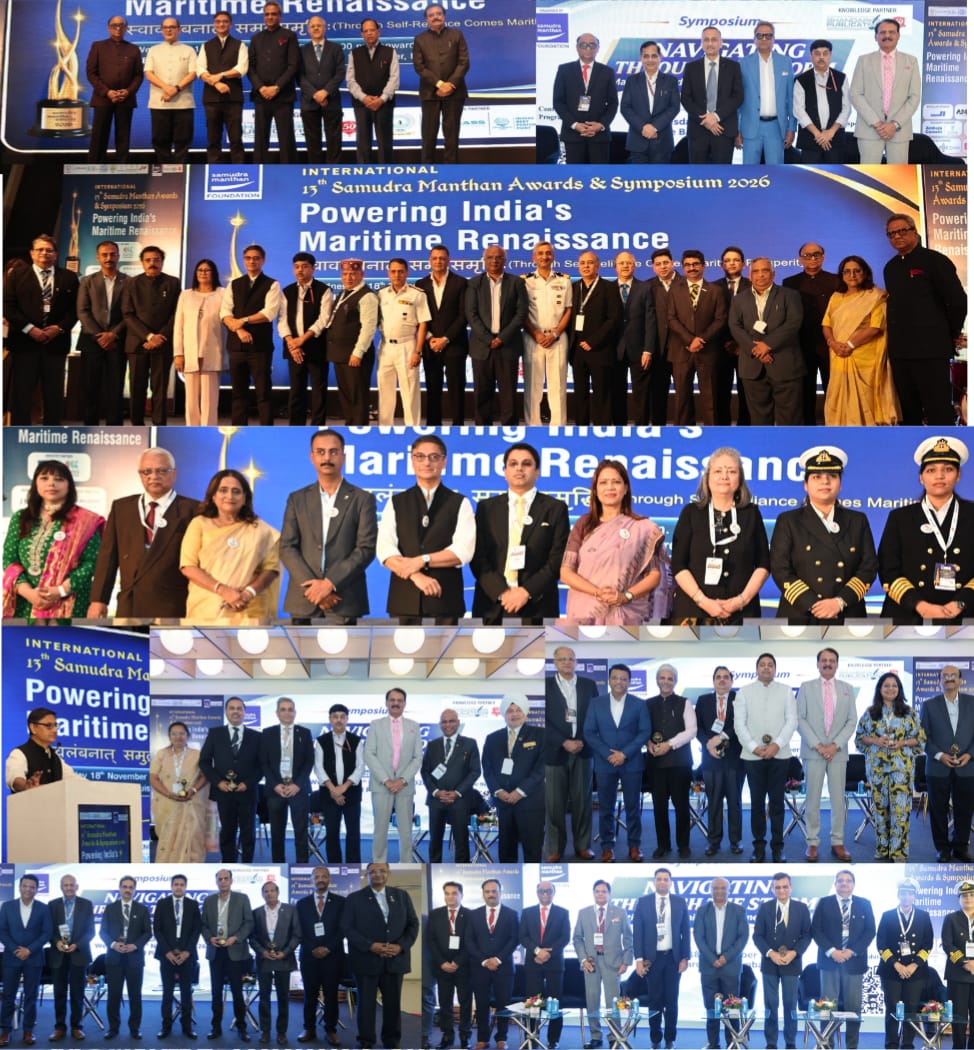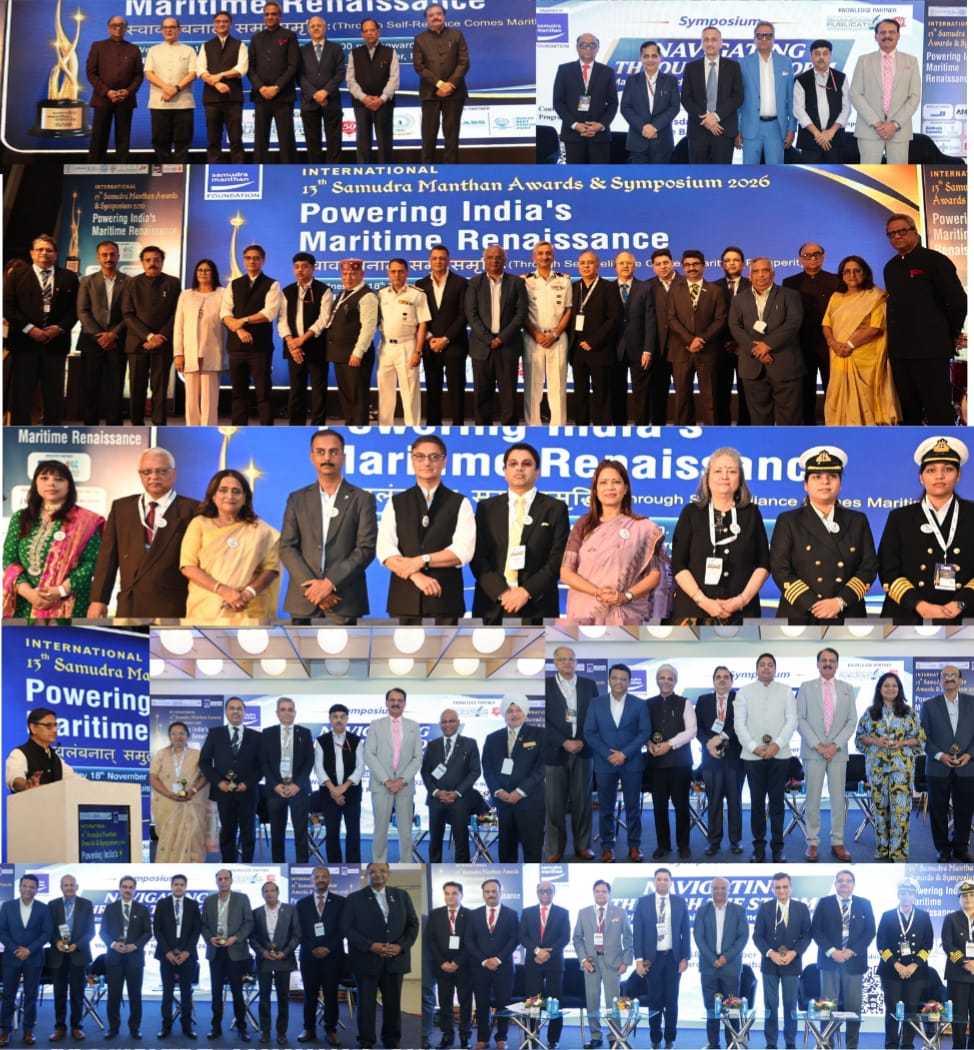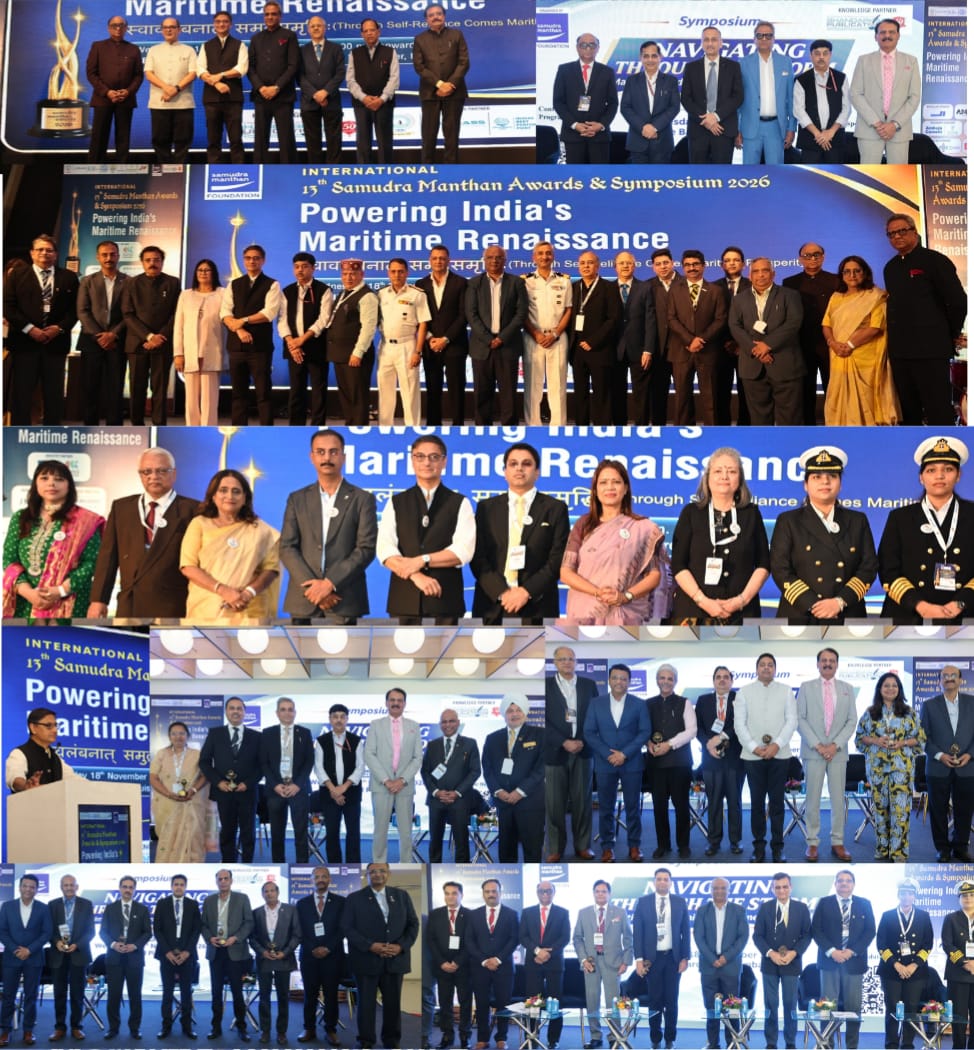
Industry Leaders and Seafarers Are Honoured at the 13th International Samudra Manthan Awards 2026
The 13th International Samudra Manthan Awards and Maritime Symposium 2026, held on November 18 at the Ballard Pier International Cruise Terminal in Mumbai, brought together senior government officials, maritime administrators, naval leadership, shipping executives, port operators, industry representatives and maritime professionals for a significant gathering celebrating excellence and addressing the future of India's maritime sector.
Organised by the Samudra Manthan Foundation, with Bhandarkar Publications as its Knowledge Partner, the event recognised distinguished contributions from the Indian Navy, Indian Coast Guard, Directorate General of Maritime Administration, Shipping Corporation of India, Indian Register of Shipping, and the shipping, ports, logistics, maritime technology, training and allied industries. The programme also featured a Maritime Symposium themed “Navigating Through the Storm: Maritime Leadership in a Fragmented World,” examining the challenges confronting global shipping and India's growing maritime ambitions.
The proceedings commenced with a welcome address by Capt. Vivek Bhandarkar, Founder and Director, Samudra Manthan Foundation, who emphasised the importance of collective action, industry collaboration and meaningful dialogue. He underscored the need to place seafarer welfare and maritime resilience at the centre of India's maritime development priorities.
Shri Sanjeev Sanyal, Member, Economic Advisory Council to the Prime Minister, delivered a compelling address on India's maritime heritage and its potential to become a major global shipbuilding and maritime power. He offered a striking perspective on India's geography, challenging the conventional notion of territorial vastness by drawing attention to the Andaman and Nicobar Islands and India's expansive maritime jurisdiction. The comparison served as a reminder that India's true geographical and strategic scale cannot be measured by landmass alone, but must also encompass its vast oceanic territory and maritime reach.
Shri Sanyal challenged conventional perceptions of India's geographical expanse, urging the audience to look beyond the country's land boundaries and recognise the enormous maritime territory that forms an integral part of its strategic footprint. He drew attention to how India's maritime zone, encompassing its coastline, island territories and Exclusive Economic Zone (EEZ), significantly reshapes the way the country's geographical scale and strategic importance can be perceived, with the Andaman and Nicobar Islands adding immense significance to its oceanic reach. His message was compelling: India must shed its land-centric outlook and begin thinking of itself as a maritime nation, with the oceans not merely defining its boundaries but opening up vast possibilities for trade, security, shipbuilding and global leadership.
He emphasised the need to strengthen domestic shipyard capacity, attract international investment and expand India's presence in global shipping and shipbuilding. The Government's proposed ₹70,000-crore shipbuilding push, together with investments in shipyards and port infrastructure, offered significant opportunities to transform the sector.
His presentation on INSV Kaundinya, inspired by a fifth-century stitched ship, connected India's ancient maritime traditions with its contemporary aspirations. The vessel, representing indigenous knowledge, traditional craftsmanship and historic maritime outreach, demonstrated how India's maritime heritage could inspire its ambitions for the future.
The prestigious Samudra Manthan Jury Awards honoured outstanding individuals whose leadership, innovation and professional contributions have shaped India's maritime and logistics industries.
Among the maritime industry stalwarts recognised with special awards was Atul Chandrakant Kulkarni, who received the Mentor of the Year award for nurturing young talent and promoting skill development. Harmesh Rahul Joshi, Executive Director of OM FREIGHT, received the Young Entrepreneur of the Year award for entrepreneurial leadership, infrastructure investments and business expansion. Nisarg Agrawal of Nagarkot Forwarders was honoured as Ship and Logistics Professional of the Year for academic distinction, international professional exposure and contributions to integrated logistics.
The institutional and industry awards celebrated organisations demonstrating excellence across the maritime ecosystem.
Under the Samudra Se Samriddhi recognitions, Jawaharlal Nehru Port Authority was honoured for excellence in container trade, Deendayal Port Authority for green hydrogen and sustainable port development, and New Mangalore Port Authority for port growth and operational excellence.
A particularly significant segment of the evening was the special institutional recognition conferred on five organisations for their contributions during the Strait of Hormuz crisis and the prevailing geopolitical situation.
The Indian Navy was honoured for safeguarding India's sovereignty and strengthening maritime security, while the Indian Coast Guard was recognised for maritime safety, search and rescue operations, and protecting lives at sea. The Directorate General of Maritime Administration was acknowledged for its leadership, coordination and vital advisories supporting seafarers during challenging circumstances.
The Shipping Corporation of India received recognition for operational resilience, contributions to national energy security and its pioneering role in oil and gas transportation from the Persian Gulf to India. The Indian Register of Shipping was honoured for five decades of classification, certification, research and technical contributions to vessel safety, indigenous shipbuilding and technological innovation.
These recognitions were presented by Shri Sanjeev Sanyal; Shri Sameer Kumar Khare, Chairman, National Shipping Board; Dr. Venkata Ramana Akkaraju, Vice-Chancellor, Indian Maritime University; Capt. Vivek Bhandarkar; and Ashish Pednekar. Capt. Girish Phadnis and Dr. Sharmil Amin, members of the Samudra Manthan Awards Committee, supported the proceedings.
Another memorable highlight was the unveiling and ceremonial pinning of the commemorative Sagar Mein Samman lapel badge, an initiative symbolising dignity, respect and recognition for the maritime community.
The initiative was led by Shri Deependra Singh Bisen, Deputy Director General (Personnel) and Deputy Director General (Vigilance), Directorate General of Maritime Administration, with the support of Capt. Savio Ramos, General Secretary, Maritime Union of India, and the Sagar Mein Samman Outreach Committee.
The badge served as a tribute to the dedication, sacrifices and invaluable contributions of seafarers and maritime professionals, whose work sustains global commerce while frequently remaining outside public attention.
The Maritime Symposium provided a platform for discussions on geopolitical uncertainty, maritime security, operational resilience, technological transformation and sustainable shipping.
Shri Sameer Kumar Khare, Chairman, National Shipping Board, presided over the inaugural session as Chief Guest. Addressing the complexities arising from geopolitical tensions, disruptions to international shipping routes and emerging security threats, he called for coordinated strategies to strengthen maritime security, protect commercial shipping and safeguard seafarers.
He emphasised the importance of collaboration among government, defence, ports, technology providers and industry, alongside indigenous capabilities and stronger operational preparedness.
The gathering also observed a minute of silence in memory of seafarers who had lost their lives amid geopolitical tensions and incidents affecting commercial shipping, particularly in the Strait of Hormuz. The solemn tribute reinforced the human cost of maritime instability and the responsibility of the international community to protect those working at sea.
The inaugural session featured addresses by Capt. B.K. Tyagi, Chairman and Managing Director, Shipping Corporation of India Ltd.; Adm. Dinesh K. Tripathi, AVSM, NM (Retd.), Chairman, National Maritime Foundation and Chairman, Samudra Manthan Foundation; and Shri Sushil Mansing Khopde, IPS, Additional Director General, Directorate General of Maritime Administration.
Capt. B.K. Tyagi discussed shipping operations, industry preparedness and the risks confronting Indian shipping and innocent seafarers. Adm. Dinesh K. Tripathi highlighted India's strategic maritime interests and the importance of cooperation between the Indian Navy and Merchant Navy. Shri Sushil Mansing Khopde emphasised maritime safety, regulatory preparedness, seafarer welfare and India's broader maritime development priorities.
Four technical sessions examined critical issues shaping the industry's future. “Command Under Crisis: Operational Resilience in Turbulent Waters” explored leadership decisions in high-risk environments, including crew safety, route diversions, insurance costs, security threats and the balance between commercial pressures and seafarer welfare.
“Smart Ports, Decarbonization & Alternate Fuel” addressed carbon compliance, European Union Emissions Trading System requirements, International Maritime Organization decarbonisation frameworks, alternative marine fuels, port electrification, cold ironing and the development of smart green ports.
“The Next Anchor: Cultivating the Future of Maritime Governance” focused on leadership, institutional trust, transparency and governance structures necessary to navigate an evolving global trade environment.
“The Geopolitical Horizon: The Choking of Waterways” examined the impact of geopolitical developments on maritime trade, freedom of navigation, protection of commercial shipping and the adequacy of international maritime laws and conventions in addressing emerging threats.
Across the discussions, industry leaders emphasised that maritime development could no longer be measured solely through infrastructure expansion, cargo volumes or commercial growth. Maritime security, environmental responsibility, institutional preparedness, technological innovation and the dignity and safety of seafarers were equally important to building a resilient industry.
The 13th International Samudra Manthan Awards and Maritime Symposium 2026 concluded by reaffirming the importance of collaboration, innovation, institutional leadership and seafarer welfare in shaping India's maritime future. Bringing together the people who lead, regulate, protect, operate and sustain the industry, the gathering celebrated professional excellence while highlighting India's opportunity to emerge as a stronger, more sustainable and globally influential maritime power.